My Best Performing Emails Have Almost Nothing to Do With Email Marketing
My emails generated over 100 clicks with fewer than 1,000 subscribers. Here's what those campaigns revealed about messaging, trust, and business growth.
Tiffany Garside
7/8/20264 min read
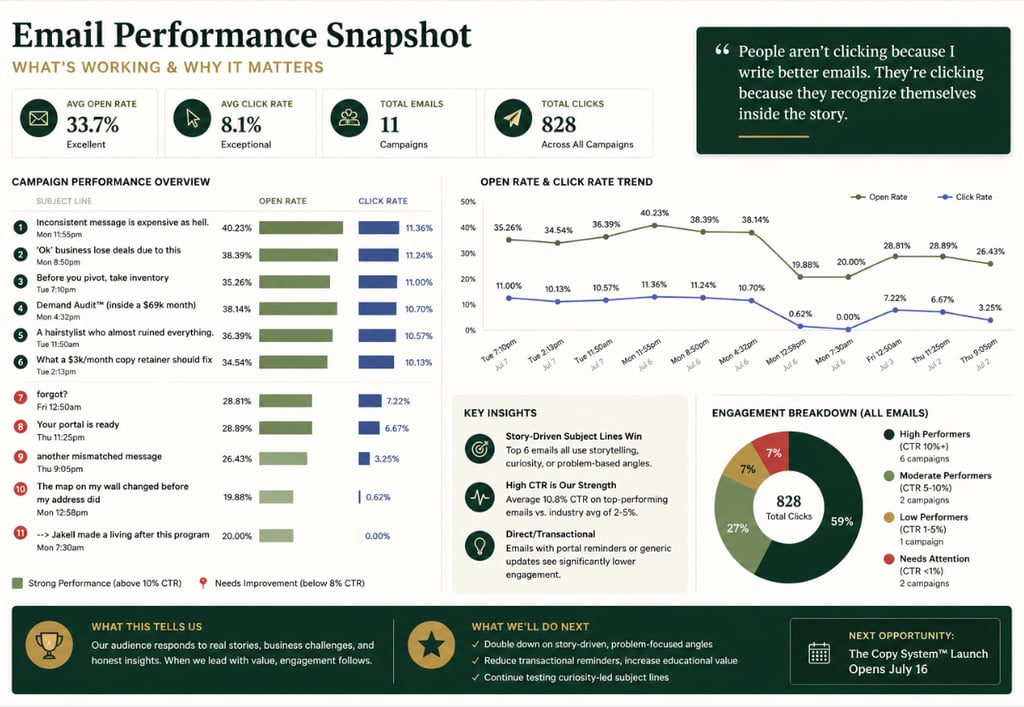
A few days ago, I opened my dashboard expecting to find another decent week of newsletter performance.
Instead, I noticed something strange.
One email generated 107 clicks.
The next generated 106.
Then 103.
Then 101.
Then 99.
Then 95.
The open rates hovered between 34% and 40%.
The click-through rates consistently landed around 10% to 11%.
And suddenly I realized something that completely changed how I think about marketing.
It wasn't the email platform.
It wasn't a new automation.
It wasn't AI.
It wasn't a "perfect" send time.
It was something much simpler.
People weren't clicking because I wrote better emails.
They were clicking because they recognized themselves inside the story.
The biggest marketing lie I see online
If you spend enough time on LinkedIn or Instagram, you'll eventually hear someone say:
"You just need a better subject line."
Or...
"Post more consistently."
Or...
"Use AI to write faster."
Those things matter.
But they aren't what creates demand.
People don't wake up hoping someone finally writes them a perfectly optimized email.
They wake up thinking...
"Why aren't more people buying?"
"Why does my business feel harder than it should?"
"Why am I explaining the same thing on every sales call?"
Those are the conversations they're already having with themselves.
My job isn't to invent new problems.
It's to articulate the ones that already exist.
That's why one of my best-performing emails wasn't called:
Five Ways to Improve Your Email Marketing
It was called:
Inconsistent message is expensive as hell.
Because it is.
I stopped teaching email.
I started diagnosing businesses.
This shift happened almost accidentally.
For years I introduced myself as an email marketer.
People immediately thought:
"Oh... newsletters."
Or...
"Oh... welcome sequences."
But that's rarely why clients hire me.
They hire me because something deeper is broken.
Their homepage sounds different from their sales page.
Their Instagram attracts one audience.
Their LinkedIn attracts another.
Their sales calls tell a completely different story.
Every piece of the business is saying something slightly different.
Individually, each message sounds okay.
Collectively, they create friction.
And friction is expensive.
A hairstylist taught me one of my favorite business lessons
One of my recent emails started with a story about a hairstylist.
Not because I suddenly became a beauty blogger.
Because everyone understands the feeling of paying for something that doesn't match what was promised.
That story had almost nothing to do with hair.
It had everything to do with expectations.
Businesses lose trust the exact same way.
Not through one catastrophic mistake.
Through dozens of tiny mismatches.
The website promises simplicity.
The proposal feels corporate.
The onboarding feels rushed.
The follow-up disappears.
None of those moments seem dramatic on their own.
Together?
They quietly convince people to keep looking.
Stories help people feel that truth before I ever explain it.
My audience doesn't actually buy email marketing
This realization surprised me.
When I looked across my highest-performing emails, I noticed a pattern.
The winners weren't about copywriting techniques.
They weren't about AI prompts.
They weren't about deliverability.
They were about confusion.
One was about pivots.
Another about inconsistent messaging.
Another about businesses losing deals.
Another about taking inventory before reinventing yourself.
Those emails weren't teaching marketing.
They were helping people make sense of their businesses.
That's a completely different job.
Marketing isn't the first problem.
Clarity is.
Imagine walking into a beautifully designed hotel.
The lobby points left.
The signs point right.
The receptionist sends you upstairs.
The elevator sends you downstairs.
Eventually you find your room.
But the experience feels exhausting.
That's what many businesses accidentally create.
The website says one thing.
The emails say another.
The social content says something else.
The founder says something different on podcasts.
Nothing feels technically wrong.
Nothing feels aligned either.
Customers notice.
Even if they can't explain why.
Why my click-through rates surprised me
Like many marketers, I used to celebrate open rates.
Now?
They're just one signal.
What matters more is what happens after someone opens.
Did they click?
Did they reply?
Did they book?
Did they trust me enough to keep reading?
Those questions tell a much richer story.
Clicks represent curiosity.
Replies represent trust.
Conversations become opportunities.
That's the sequence I'm trying to build.
The shift every founder eventually has to make
Early in business, your expertise does most of the selling.
Later, your messaging does.
You can't personally explain your offer to every visitor.
You can't jump into every inbox.
You can't attend every discovery call.
Eventually your words have to work while you're offline.
That's why messaging deserves so much more attention than it usually receives.
Not because words are magical.
Because consistency compounds.
What I'm building now
Over the last decade, I've worked with founders, financial firms, education companies, healthcare organizations, SaaS brands, and growing businesses.
The common denominator was never their industry.
It was clarity.
The companies that grew the fastest weren't always the smartest.
They were the easiest to understand.
That's what I've been quietly documenting.
Not another collection of templates.
Not another AI prompt library.
A system.
A way to evaluate your business before you rewrite it.
A framework for understanding what stays, what goes, and how every touchpoint should reinforce the same promise.
That's exactly why I created The Copy System.
It isn't an email course.
Email is simply one expression of a much bigger idea.
It's about creating a business that sounds like the same company everywhere your customers encounter it.
Website.
LinkedIn.
Instagram.
Sales calls.
Welcome emails.
Launches.
Everywhere.
Because when your message becomes consistent, your marketing becomes easier.
Your sales conversations become shorter.
Your referrals become stronger.
Your content becomes simpler to create.
And your business becomes easier to trust.
One question before you rewrite another headline
Before you redesign your homepage.
Before you launch another offer.
Before you ask AI to generate another hundred captions...
Ask yourself this:
If someone read my website, my last newsletter, my LinkedIn profile, and my Instagram today...
Would they think they came from the same business?
If the answer is no...
Don't start by creating more content.
Start by creating more clarity.
Everything else gets easier from there.
The Copy System opens July 16.
If you've built a business that has grown faster than its messaging, this is for you.
We'll take inventory before we reinvent.
We'll build a message your customers can understand, repeat, and trust.
Because the businesses that win over the next decade won't necessarily be the loudest.
They'll be the ones that are impossible to misunderstand.